
History of the Abbey
Following their invasion of England in 1066, the Normans encouraged colonists from their home grounds to occupy the new land. Although the conquest of much of Wales took a couple of hundred years longer than the few days of the English occupation, Norman knights made gradual progress into the southern parts of what is now Wales.
By 1140, the Bishop of St Davids felt confident in inviting a group of Cistercian monks from the abbey in Clairvaux to come and set up a new monastery at a place called Alba Landa.
At this time, several other abbeys were set up initially as missionary outposts of an existing French monastery. Like the marcher castles, it was a way of helping to establish a Norman order. Smaller churches found their lands appropriated by invading knights, and priests and services in the Celtic tradition replaced by the Catholic versions preferred by the colonists.
The church records tell us that although the missionaries first arrived in 1140, they did not occupy the Whitland site until 1151. Funding an Abbey was one way a wealthy landowner could improve his credit with God, and the land and likely the buildings were granted by William Fitz Hay the lord of St Clears, half brother of Bishop David Fitz Gerald
The name “Whitland” is a version of the original Welsh Ty Gwyn ar Taf, or the Norman French Blanchland, or in the Latin used by the Church, Alba Landa.
Whitland was where the Welsh prince Hywel Dda convened a council to draw up a code of Welsh laws in 940.
As the 12th century progressed, Whitland Abbey established further missions to the north, such as the abbey’s at Strata Florida; Strata Marcella, Cwmhir and two in Ireland.
The gradual spread of Norman influence wasn’t entirely a story of one set of people oppressing another. Many deals were done with Welsh leaders, notably The Lord Rhys ap Gruffudd, who maintained a complex relationship with King Henry II in London. Some of the time they were great pals, organizing marriages between Rhys’ daughter and a Norman knight; other times, Henry was ordering Rhys’ youngest Son to be blinded. Rhys occupied and extended various castles originally built as Norman footholds, making good use of them as administrative centres. He also patronized Whitland and other abbeys.
Whitland became an important religious centre. Welsh princes were buried there in the 12th and 13th centuries. In those days, monasteries played an important role as hostels for travellers, and Whitland was obviously a 5-star accommodation. Important visitors stayed overnight. For many years, the wall of the refectory sported a picture of the Archbishop of Canterbury and Gerald of Wales sitting taking a drink with the Abbot, alongside a meade mat signed by Baldwin and a copy of the page out of Gerald’s Journey through Wales in which the Abbey is mentioned.
The Welsh Abbot installed by the Lord Rhys was the first of a succession, and the Abbey came to be strongly influenced in the Welsh cultural tradition. By the middle of the 13th century, when tensions between the Welsh and the Normans were high, there were several raids by Norman knights. Although the Abbey eventually declared allegiance to the Norman crown in London, the monks were never really trusted by the English lords, and the Abbey was frequently punished for suspected loyalty to Welsh rebels.
The Abbey did not escape Henry VIII’s dissolution of the monasteries, and in 1538 the monks dispersed and services were ceased.
Local landowners took over the site and gradually dismantled it, using the stones for their own buildings.
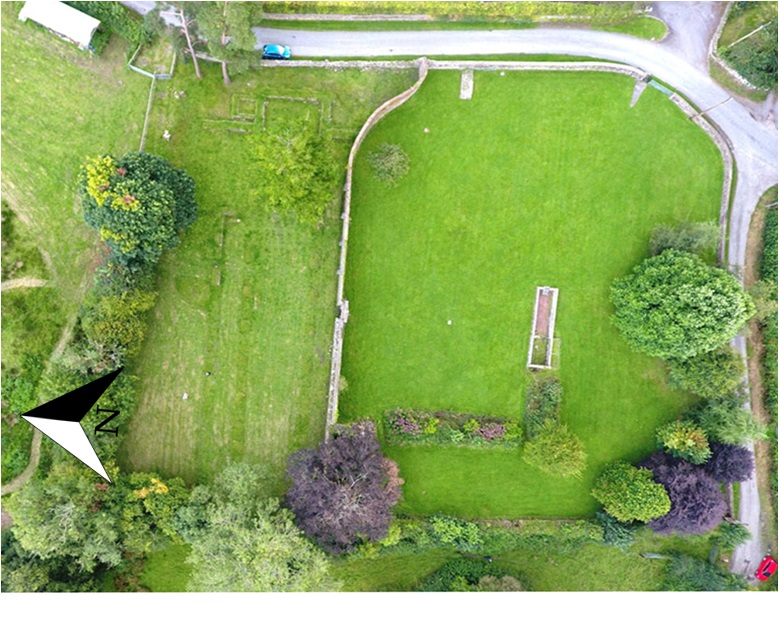
Part of the site became a walled garden in the 19th century, the wall being built over parts of originals, and is now a boundary of the public part of the site.
The significance of the historical site was rediscovered in the 20th century and archaeological digs were carried out in 1929 and 1995.
Sources:
- Whitland Abbey through the Centuries, Elizabeth Birt, Western Telegraph 21st Jan 2023.
- Whitland Abbey in Ancient Monuments